bg-banner
shape

Department of Geography

Department of Geography

HOD

Prof. Dr. P. S. Raut

H.O.D.

Warana Mahavidyalaya, Warananagar has been established in 1964. The geography subject has introduced to pre-Degree level in the year 1967. It started at B. A. I and B. Sc. I, since June 1968 and at B. A. II and B. A. III level in the year June 1970 and June 1971 respectively. The full-fledged department of Geography came in force in the academic year 1971-1972. Thus, for last 54 years the students from B. A. classes are obtaining degree in the subject Geography and as subsidiary subject.

Vision

‘Create an environment that is advanced in academics, science and society for the in order to help become responsible, competent citizens of the world.’

Mission

‘To provide higher education by developing students’ multi-dimensional, geo-spatial awareness for national and international competency’. Objectives :

  • To familiarize the students with the foundational ideas of the geography in order to encourage their creativity and research orientation.
  • To assist hasten the students exploration of cutting-edge geospatial technology using both theory and practical as teaching tools.
  • To better prepare students with the knowledge and abilities required to seek higher education in a number of geography-related fields.

Dr. R. N. Hardikar was the founder head, famous writer and research guide of the department and the well-known writer and research guide. Dr. S. B. Sarang made the department renowned in the Shivaji University.Dr. Hardikar wrote and Dr. S. B. Sarang wrote seven books, guided for 2 M. Phil and 8 Ph. D. Students. Dr. S. B. Sarang served as principal for 7 years. The Assistance colleague Dr. S. B. Kanase shouldered the NCC and promoted as a principal at Mahavir College, Kolhapur. Dr. P. S. Raut is,Associate Professor and working head of the department and Dr. R. B. Patil (Associate Professor) is colleague of him. Mr. A.N. Yadav and Dr. T. T. Waghmare are the contributary Assistance Professor of the department. The geography department organizes the various student centric activities such as filed visit, e-mail sending workshop, village survey, excursion tours, seminars, debate, group discussion, Nirmalya Sankalan etc.

Courses Offered

Departmental Highlights

Faculty Profile

Sr. No. Name of Faculty Qualification Designation Experience
1 Dr. Raut Prakash Soudagar M.A., B. Ed., Ph.D. Head & Associate Professor 27 Years
2 Dr. Patil Rajaram Baburao M.A., B. Ed., SET., Ph.D. Associate Professor 23 Years
3 Dr. Waghmare Tushar Tukaram M.A., NET., SET., Ph.D. Assistant Professor (CHB) 05 Years
4 Mr. Yadav Amar Namdev M.A., SET. Assistant Professor (CHB) 04 Years

Activities

Activities content here.

Achievements

Department Achievements (2017-18 to 2022-23)
1) Research Publications
Sr. No. Name of Student Date Title Description
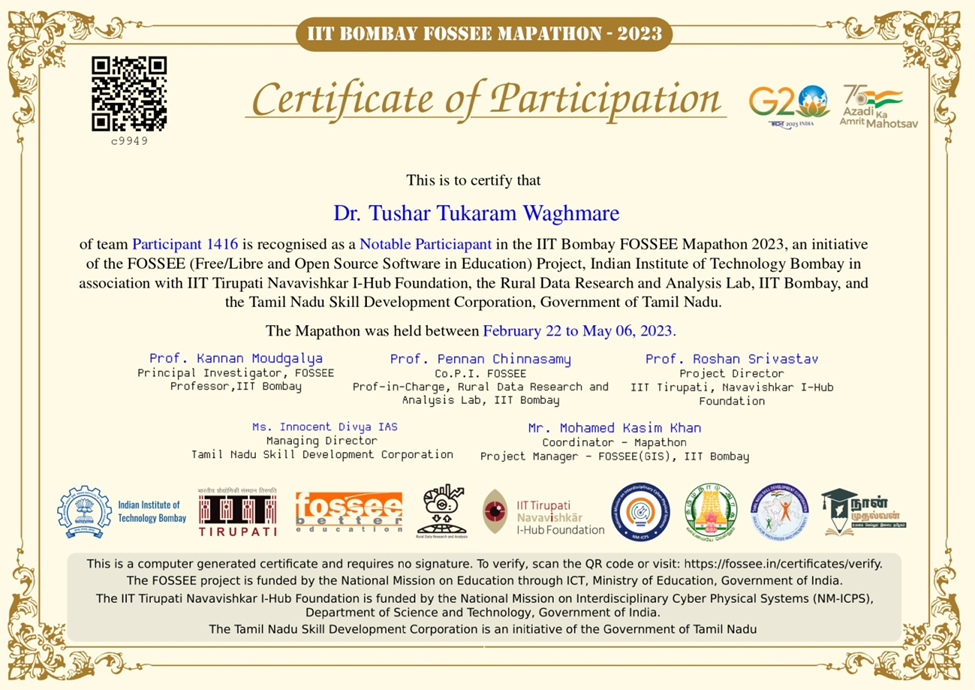
1. Dr. Tushar Tukaram Waghmare 22/05/2023 IIT Bombay Fossee Mapathon-2023 (Notable Participant) National Level Mapathon Competition taken by IIT Bombay
2) Students Publications
Sr. No. Name of Student Date Title Description
1. Komal Arjun More 12/10/2023 12/10/2023 Stood first at last year examination among all discipline in Y.C.W. Mahavidyalaya Warananagar

Prominent Alumni

Sr. No. Name of Alumni Company/ Organization Designation Contact
1Dr. Rathod Balu LaxmanKankwali College, Kankavali Dist. ShindhudurgAssistant Professor9822348855
2Dr. Patil Swati VishnuWillingdon College, Sangli Dist. SangliAssistant Professor9765293651
3Dr. Patil Abhijit SambhajiP. G. Diploma in Geoinformatics, Shivaji University, KolhapurAssistant Professor9765396271
4Mr. Patil Vishwas AnandaDistrict Court, KolhapurAdvocate9960428890
5Mr. Patil Prabhakar ShivajiFounder and Manager, Adventure Industry, Shiroli MIDC, KolhapurFounder and Manager7745095548
6Mrs. Lad Asmita BabasoSinghagad Police Station, PunePolice Sub- Inspector8830597441
7Mr. Potdar Sandip VilasBusiness Goldy- Gold Jeweller A/P. Kodoli Tal.Panhala Dist. KolhapurFounder and Manager9921429257
8Shri Mandlik Rahul AppsoSuperintendent of Police Office, RaigadPolice Constable8080719266
9Mr. Mane-Patil Rushikesh SarjeraoIndian Army 17, Maratha Light Infantry Bhuj, Gujarat, IndiaSoldier in Indian Army9325850902
10Mr. Sividnya Sunil PatilSurvey of India, Office PuneGIS Engineer7559492752

Best Practices

Title

Department of Geography organizes Field Visit and Village Survey as a co-curricular activity.

Objectives
  • To observe and analyze the landscape features.
  • To find out the correlation between natural elements and human life.
Context

Geography is cannot be taught in the four walls. The students should get an opportunity to observe that is taught in the classrooms. The content of subject is related to natural environment. The natural environment effects on the human activities and human life. The students should analyze the impact of nature by observation and co-relation method. Field visits are experiential learning activities that entail traveling to a designated site in order to observe, investigate, and gain knowledge about a given subject or topics.

Best Practices Outcomes
  • 1) Enhanced Comprehension: Field trips give participants a more thorough and useful comprehension of a subject. For instance, seeing geological places can help geology students understand rock structures better.
  • 2) Application of Knowledge: Participants can put their theoretical knowledge to use in practical settings by going on field visits. Biology students, for example, are able to see and recognize different plant and animal species in their native environments.
  • 3) Data Collection: In order to gather information for their studies, researchers frequently visit fields. From scientific research to market research, this data can be used for a variety of study projects.
  • 4) Environmental Awareness: Going to natural areas can help people become more conscious of environmental issues like biodiversity, conservation, and sustainable living.
  • 5) Problem-Solving Ability: During field visits, participants could run into difficulties or unanticipated circumstances. This can foster the growth of adaptability and problem-solving abilities.
  • 6) Critical Thinking: Forming hypotheses and engaging in critical thinking can be facilitated by evaluating and interpreting observations made during a field visit.
  • 7) Validation and Verification: Information, assertions, and hypotheses are frequently validated or verified by field visits. This is significant in a number of areas, such as science and research.
Best Practices Field Visits
Sr. No. Location Class Date
1Seema Bio-Tech, TalsandeB. A. II21/02/2014
2Pawankhind, Vishalgad and AambaB. A. III22/09/2015
3Warana Sugar FactoryB. A. III05/03/2016
4Parivane, ParleshwarB. A. III04/02/2017
5Masai Plateau, Pawankind and AambaB. A. I17/09/2022
6Ajara, Hiranykeshi River valley, AmboliB. A. I10/09/2023
Best Practices Village Survey
Sr. No. Location Class Date
1Boriwade Tal. Panhala Dist. KolhapurB. A. III20/12/2017
2Wekhandwadi Tal. Panhala Dist. KolhapurB. A. III09/01/2019
3Nilewadi Tal. Hat. Dist. KolhapurB. A. III20/12/2019
4Pariwane Tal. Shahuwadi Dist. KolhapurB. A. III17/12/2021
5Ukhalu Tal. Shahuwadi Dist. KolhapurB. A. III18/11/2022

Placement & Progression

Placement data here.

Research Publications

Sr. No. Name of Faculty International National
1Dr. Raut Prakash Soudagar1001
2Dr. Patil Rajaram Baburao1102
3Dr. Waghmare Tushar Tukaram1201

Career Opportunities